USDJPY: Sellers hold the structural edge inside the recent range
USDJPY closed at 159.152, with a bearish H1 bias of moderate confidence despite limited indicator confirmation.
For technical education only, not trading advice; not a win-rate or probability, and does not guarantee profit.
Short answer
USDJPY has a bearish H1 bias with moderate confidence, based on lower highs and lower lows. The watch zone at 159.156 to 159.173 sits just above the last close. Tokyo Core CPI y/y is the key upcoming event for the yen.
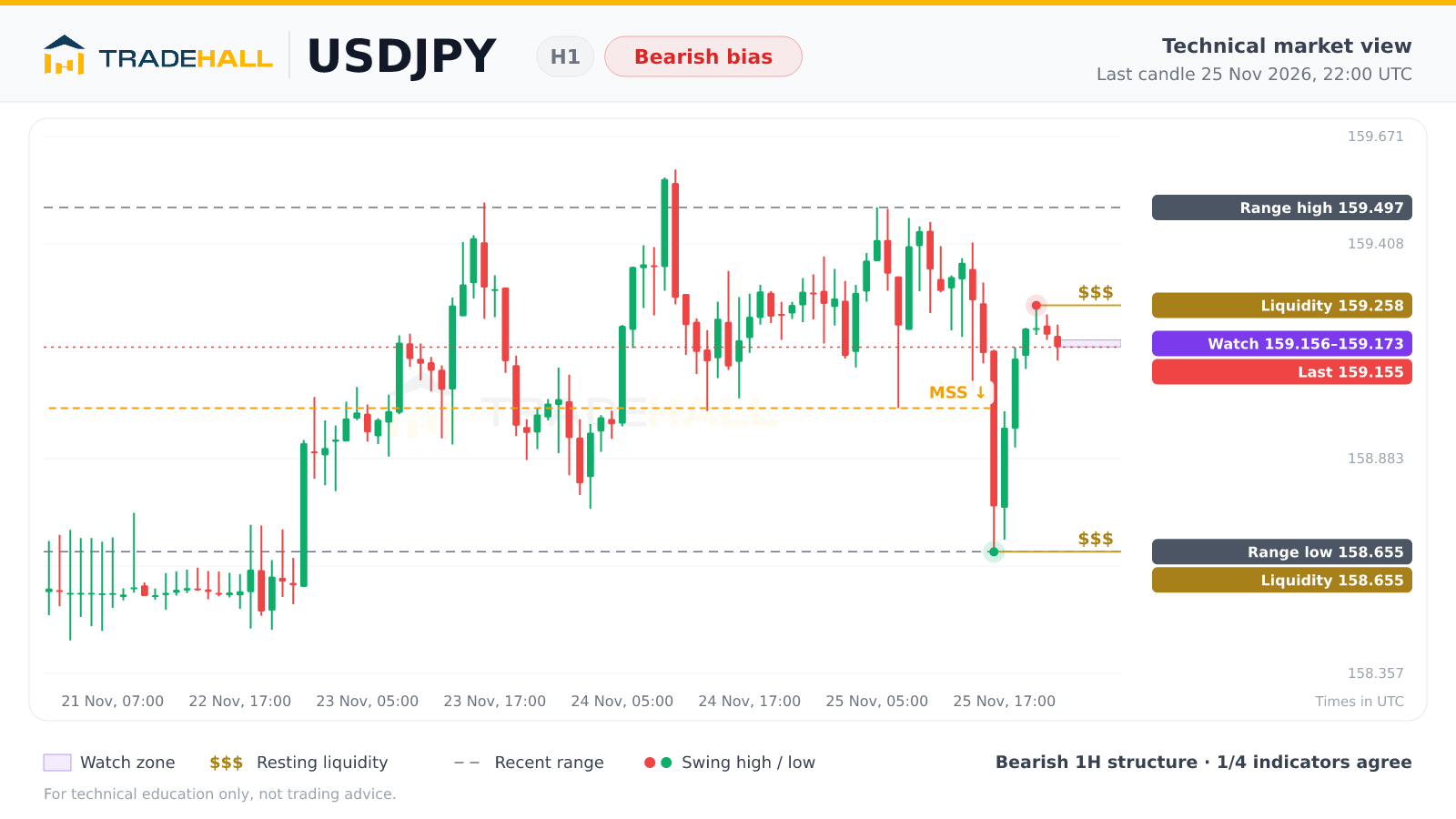
USDJPY analysis, 26 November 2026. USDJPY last closed at 159.152 on 25 November 2026, 23:00 UTC. The H1 structure supports a bearish bias, though confidence is moderate because most indicators do not confirm it.
Technical picture
Lower highs and lower lows set the bearish H1 bias. Only 1 of 4 indicators agrees: MACD is Down. RSI is Neutral, while Stochastic and MA trend are Up, limiting confirmation of the structural read.
The last close sits just above the midpoint of the recent range and below the watch zone. The watch zone is a fair value gap where price has reacted before and may react again. Resting liquidity lies above the close and at the range low.
- Bias: bearish (moderate).
- Indicator agreement: 1 of 4 indicators agree.
- Recent range: 158.655 to 159.497, midpoint 159.076.
- Watch zone: 159.156 to 159.173 (fair value gap).
- Resting liquidity above: 159.258.
- Resting liquidity below: 158.655.
- Typical daily move: 0.694.
- Last close: 159.152 at 23:00 UTC on 25 November 2026.
How the news fits the chart
No news development has been supplied to confirm or challenge the bearish bias. The upcoming Tokyo Core CPI y/y release is the key development for USDJPY. Its effect on expectations for Japanese interest rates could matter for the yen.
A hold above the range high at 159.497 could strengthen the structure. A loss of the range low at 158.655 could reinforce the bearish structure. A CPI reading that changes Japanese rate expectations could alter the yen's fundamental backdrop.
On the calendar
Tokyo Core CPI y/y matters for USDJPY because it could influence expectations for Japanese interest rates and the yen.
| Time (UTC) | Currency | Event | Impact | Forecast | Previous |
|---|---|---|---|---|---|
| 26 November 2026 23:30 | JPY | Tokyo Core CPI y/y | Medium | 3.0% | 2.6% |
Levels to watch
- 159.497: The range high; a hold above it could strengthen the structure.
- 159.258: Resting liquidity above the last close; a reaction here could reveal whether sellers retain control.
- 159.156 to 159.173: The watch zone; a rejection could support the bearish structure, while a hold above it could challenge it.
- 159.076: The recent range midpoint; a sustained move across it could clarify control within the range.
- 158.655: The range low and resting liquidity below price; a loss could reinforce the bearish structure.
How to read this analysis
This note is built from the technical read of TradeHall's AI Analysis, a page of the TradeHall client platform. The bias is the direction the structure leans, and the confidence says how firm that read is. The recent range is the area price has moved in lately, with its range high, range low and midpoint. A watch zone is an area where price reacted before and may react again. Resting liquidity marks levels where orders tend to gather. None of these is an instruction: they describe the chart.
Frequently asked questions
What is the technical bias on USDJPY today?
USDJPY closed its last H1 candle at 159.152 (23:00 UTC, 25 November 2026). The technical read is bearish and moderate: 1 of 4 indicators agree with it. Price is inside a recent range from 158.655 to 159.497.
Which economic events matter for USDJPY this week?
Tokyo Core CPI y/y matters for USDJPY because it could influence expectations for Japanese interest rates and the yen.
Which price areas matter on USDJPY right now?
Recent range: 158.655 to 159.497, midpoint 159.076. Watch zone: 159.156 to 159.173. These are areas where price may react. They describe the chart and are not instructions.
Is this analysis trading advice?
For technical education only, not trading advice; not a win-rate or probability, and does not guarantee profit.
For technical education only, not trading advice; not a win-rate or probability, and does not guarantee profit.