GBPUSD: Sterling near range low as Fed rate talk supports dollar
Hawkish Fed signals and steady UK core inflation weighed on GBPUSD, leaving its H1 technical bias moderately bearish near the recent range low.
For technical education only, not trading advice; not a win-rate or probability, and does not guarantee profit.
Short answer
Fed rate expectations supported the dollar as steady UK core inflation tempered expectations for another near-term Bank of England increase. GBPUSD has a bearish H1 bias with moderate confidence, although its structure remains mixed. The watch zone just above the last close is the nearest area of interest.
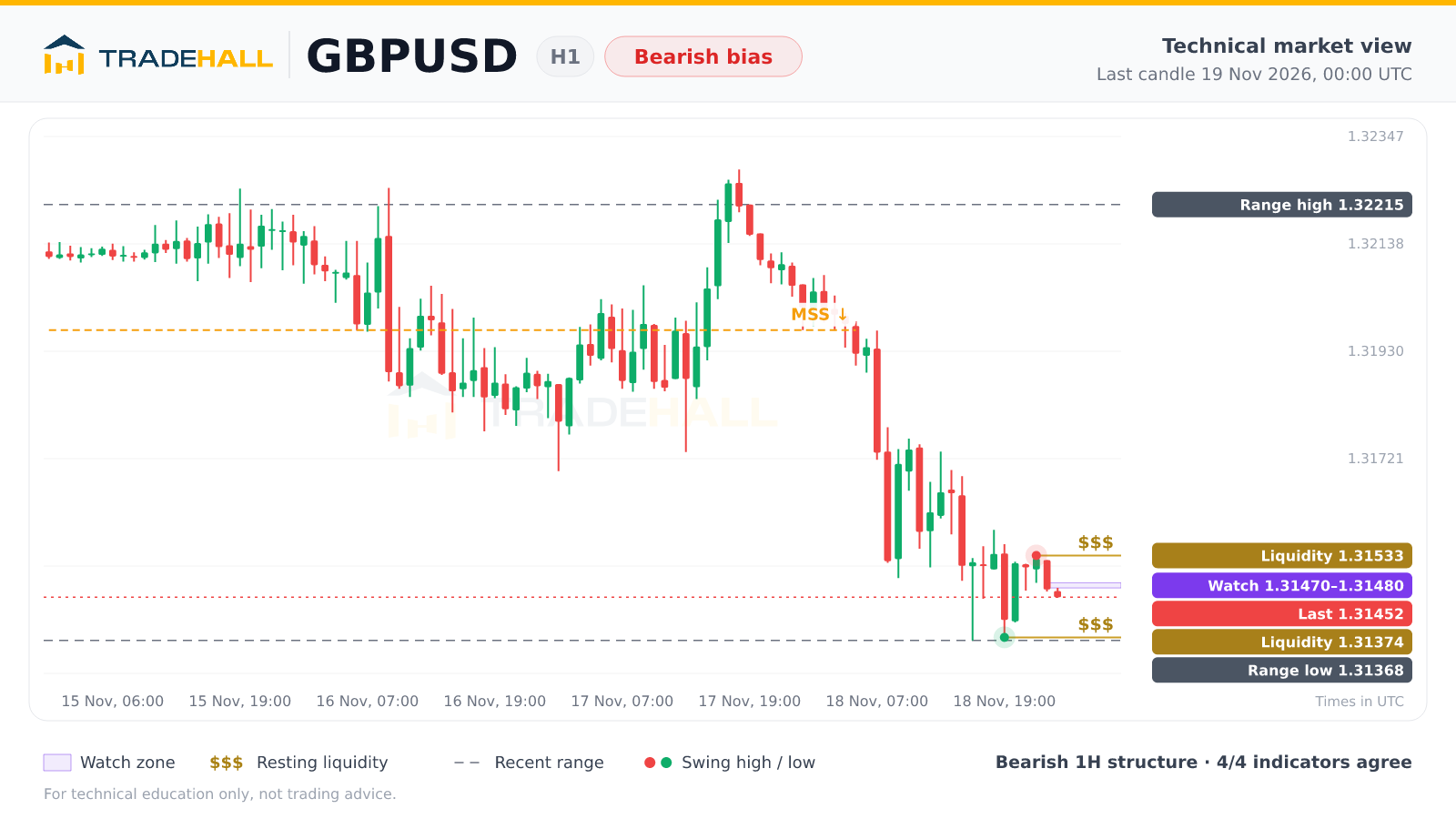
GBPUSD analysis, 19 November 2026. Hawkish Fed comments and minutes supported the dollar as sterling slipped to a one-month low. GBPUSD last closed at 1.31452 on H1 at 19 November 2026, 00:00 UTC. The bias is bearish with moderate confidence, although the structure is not clean.
What is driving the market
Fed officials' focus on inflation strengthened expectations of further US rate increases, supporting the dollar against sterling. Steady UK core inflation tempered expectations for another near-term Bank of England increase, adding pressure to GBPUSD. Slower UK pay growth also points to easing wage pressure, although sterling was little changed after those figures. Earlier US retail sales showed underlying strength, but the dollar slipped as Treasury yields fell.
- Reuters, 18 November 2026, 19:01 UTC: Fed minutes showed almost all policymakers saw further rate increases as appropriate if the economy developed as expected. Some discussed a larger increase if inflation data were unfavorable.
- Reuters, 18 November 2026, 13:28 UTC: Fed Governor Christopher Waller called for a more aggressive inflation response. The dollar touched a 19-month high, while sterling fell to a one-month low.
- Reuters, 18 November 2026, 10:03 UTC: UK core inflation held at 2.8%, tempering expectations for another near-term Bank of England rate increase. Sterling fell against a broadly stronger dollar.
- Reuters, 17 November 2026, 15:27 UTC: US retail sales showed underlying strength in October. The dollar slipped against a basket of currencies as Treasury yields fell.
- Reuters, 17 November 2026, 07:07 UTC: UK pay growth slowed while vacancies fell to their lowest since 2021. Sterling was little changed after the data.
Technical picture
The H1 bias is bearish with moderate confidence, but mixed highs and lows leave the structure unclear. MACD, RSI, Stochastic and MA trend all point down, confirming rather than setting the direction. The last close sits near the range low and below the midpoint of the recent range.
The watch zone is just above the last close and is backed by a fair value gap. Resting liquidity lies above price beyond that zone, while another pool sits below the close. The lower pool remains just above the range low, so a loss of that edge would leave it behind.
- Bias: bearish (moderate).
- Indicator agreement: 4 of 4 indicators agree.
- Recent range: 1.31368 to 1.32215, midpoint 1.31792.
- Watch zone: 1.31470 to 1.31480 (fair value gap).
- Resting liquidity above: 1.31533.
- Resting liquidity below: 1.31374.
- Typical daily move: 0.00586.
- Last close: 1.31452 at 00:00 UTC on 19 November 2026.
How the news fits the chart
The Fed's inflation focus is the most important development for GBPUSD because it supports US rate expectations and the dollar. That pressure agrees with the bearish H1 bias, although the chart's mixed structure limits confidence. The coming calendar events have no established directional effect before their results are known.
A hold above 1.32215 would strengthen the structure and challenge the bearish bias. A loss of 1.31368 could indicate greater control by sellers. The GBP Retail Sales m/m release could also affect sterling through its implications for UK growth and rate expectations.
On the calendar
USD Unemployment Claims and GBP Retail Sales m/m matter for GBPUSD because they can influence growth and rate expectations on each side of the pair. Revised UoM Inflation Expectations could also affect the US rate outlook.
| Time (UTC) | Currency | Event | Impact | Forecast | Previous |
|---|---|---|---|---|---|
| 19 November 2026 13:30 | USD | Philly Fed Manufacturing Index | Medium | 20.6 | 20.9 |
| 19 November 2026 13:30 | USD | Unemployment Claims | Medium | 198K | 200K |
| 20 November 2026 07:00 | GBP | Retail Sales m/m | Medium | 0.0% | -0.4% |
| 20 November 2026 15:00 | USD | Revised UoM Consumer Sentiment | Medium | 51.7 | 51.0 |
| 20 November 2026 15:00 | USD | Revised UoM Inflation Expectations | Medium | - | 4.3% |
Levels to watch
- 1.32215 is the range high; a hold above it would strengthen the structure and challenge the bearish bias.
- 1.31792 is the recent range midpoint; a sustained move above it would show that price has recovered the upper half of the range.
- 1.31533 is resting liquidity above price; a reaction there could show whether the recovery is sustaining itself.
- 1.31470 to 1.31480 is the watch zone backed by a fair value gap; a reaction there could show whether nearby pressure persists.
- 1.31374 is resting liquidity below price; a reaction there could show whether the area near the range low is holding.
- 1.31368 is the range low; a loss of that edge could indicate greater control by sellers.
How to read this analysis
This note is built from the technical read of TradeHall's AI Analysis, a page of the TradeHall client platform. The bias is the direction the structure leans, and the confidence says how firm that read is. The recent range is the area price has moved in lately, with its range high, range low and midpoint. A watch zone is an area where price reacted before and may react again. Resting liquidity marks levels where orders tend to gather. None of these is an instruction: they describe the chart.
Frequently asked questions
What is the technical bias on GBPUSD today?
GBPUSD closed its last H1 candle at 1.31452 (00:00 UTC, 19 November 2026). The technical read is bearish and moderate: 4 of 4 indicators agree with it. Price is inside a recent range from 1.31368 to 1.32215.
What is moving GBPUSD right now?
Fed officials' focus on inflation strengthened expectations of further US rate increases, supporting the dollar against sterling. Steady UK core inflation tempered expectations for another near-term Bank of England increase, adding pressure to GBPUSD. Slower UK pay growth also points to easing wage pressure, although sterling was little changed after those figures. Earlier US retail sales showed underlying strength, but the dollar slipped as Treasury yields fell.
Which economic events matter for GBPUSD this week?
USD Unemployment Claims and GBP Retail Sales m/m matter for GBPUSD because they can influence growth and rate expectations on each side of the pair. Revised UoM Inflation Expectations could also affect the US rate outlook.
Which price areas matter on GBPUSD right now?
Recent range: 1.31368 to 1.32215, midpoint 1.31792. Watch zone: 1.31470 to 1.31480. These are areas where price may react. They describe the chart and are not instructions.
Is this analysis trading advice?
For technical education only, not trading advice; not a win-rate or probability, and does not guarantee profit.
Sources
- Reuters: Fed policymakers focused on inflation risks in October, with some seeing need for bigger rate hike
- Reuters: Dollar firmer as hawkish Waller backs aggressive Fed action
- Reuters: Sterling slips to one-month low versus dollar after UK core inflation steadies
- Reuters: US retail sales showcase underlying strength despite cost-of-living crunch
- Reuters: UK pay growth slows as job vacancies hit lowest since 2021
For technical education only, not trading advice; not a win-rate or probability, and does not guarantee profit.