GBPUSD: Sterling weakens on dollar strength as chart bias remains bearish
Higher US yields and inflation have supported the dollar against sterling, leaving GBPUSD with a moderate bearish bias despite conflicting market structure.
For technical education only, not trading advice; not a win-rate or probability, and does not guarantee profit.
Short answer
Higher US yields, inflation and Federal Reserve comments have supported the dollar against sterling. The GBPUSD bias is bearish with moderate confidence, although higher highs and higher lows conflict with that label. The range high is the key area for assessing whether the structure strengthens.
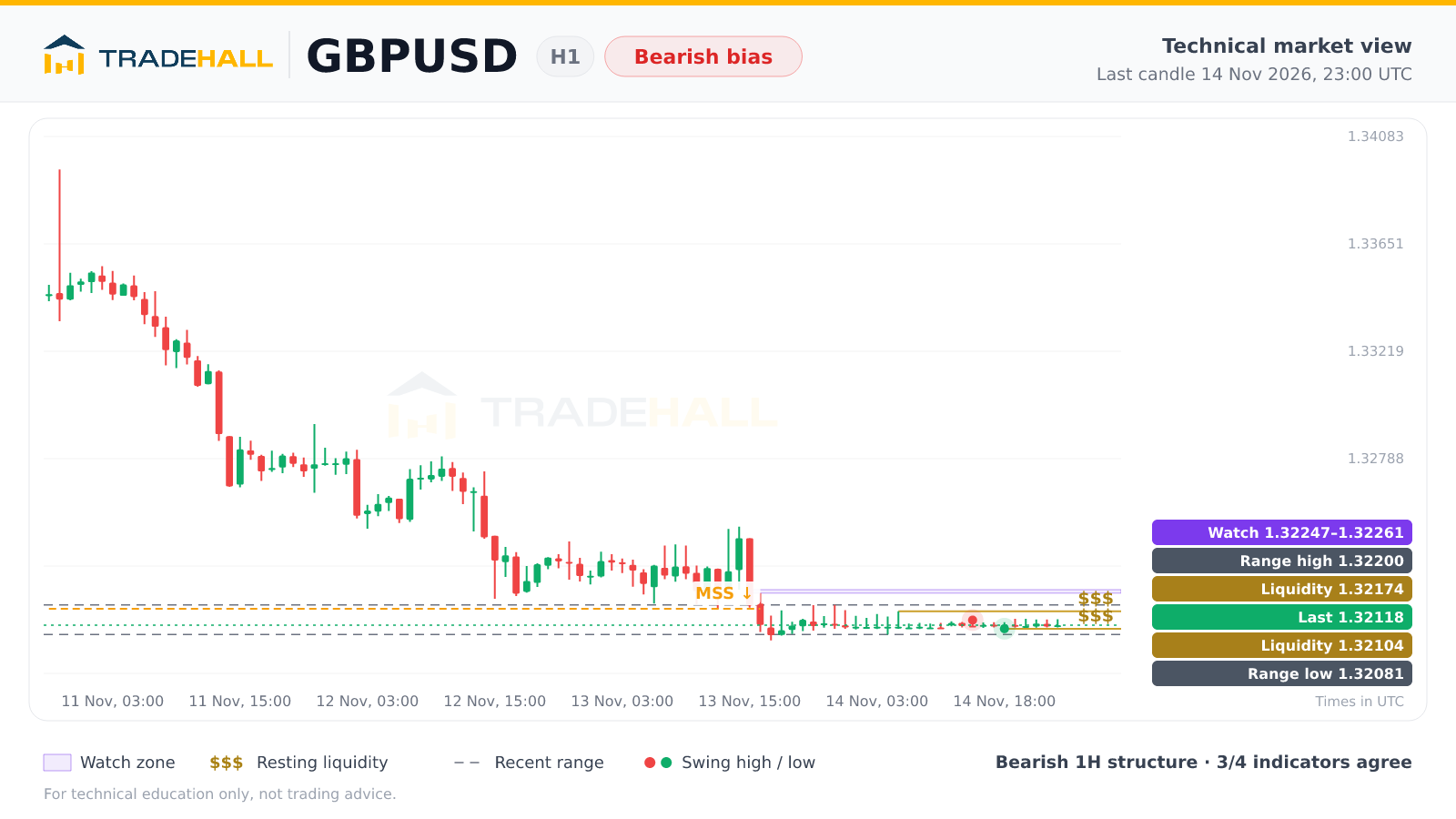
GBPUSD analysis, 15 November 2026. A stronger dollar drove sterling toward its largest weekly drop since September, according to Reuters. GBPUSD last closed at 1.32113, with a bearish bias and moderate confidence.
What is driving the market
US inflation and higher yields have supported the dollar, weighing on GBPUSD. Federal Reserve comments also point to continuing rate increases, which can support dollar yields. Bank of England officials have signalled further inflation concerns, offering a counterweight through the outlook for UK rates.
- Reuters 13 November 2026, 12:00 UTC: Sterling was headed for its largest weekly drop since September. Reuters attributed the weakness mainly to a stronger dollar.
- U.S. Bureau of Labor Statistics 13 November 2026, 13:30 UTC: US producer prices rose 0.3% in October and 6.5% over 12 months.
- The Independent 14 November 2026, 17:05 UTC: Huw Pill signalled support for another quarter-point Bank of England rate increase in December. He also expected further rises to be needed in 2027.
- Reuters 14 November 2026, 15:46 UTC: Susan Collins favoured gradual Federal Reserve rate increases. She cited broadening inflation and the potential effect of higher longer-term rates on demand.
- Reuters 14 November 2026, 12:57 UTC: Megan Greene argued that acting early on inflation was less risky than waiting. She was among the policymakers who voted to raise Bank Rate in November.
Technical picture
The H1 bias is bearish with moderate confidence, and 3 of 4 indicators agree. RSI, Stochastic and MA trend point down, while MACD points up. However, the reported higher highs and higher lows conflict with the bearish bias. Indicators can confirm a bias, but do not set the direction.
The last close sits below the recent range midpoint and near the range low. Resting liquidity is present on both sides of the close, within the recent range. The fair value gap watch zone sits above the range high and marks an area of previous reaction.
- Bias: bearish (moderate).
- Indicator agreement: 3 of 4 indicators agree.
- Recent range: 1.32081 to 1.32200, midpoint 1.32141.
- Watch zone: 1.32247 to 1.32261 (fair value gap).
- Resting liquidity above: 1.32174.
- Resting liquidity below: 1.32104.
- Typical daily move: 0.00599.
- Last close: 1.32113 at 00:00 UTC on 15 November 2026.
How the news fits the chart
Dollar strength from higher US yields and inflation aligns with the bearish bias. The key development is US inflation pressure, given its influence on Federal Reserve rates and the dollar. Bank of England rate signals pull against that bias by supporting sterling. The reported higher highs and higher lows also disagree with the bearish label.
A hold above 1.32200 would strengthen the structure and place price above the resting liquidity at 1.32174. A reaction at the 1.32247 to 1.32261 watch zone could show whether that strength persists. A loss of 1.32081 would weaken the recent range structure. The resting liquidity at 1.32104 lies above that range low, not below it.
Levels to watch
- 1.32200: The range high. A hold above it would strengthen the structure.
- 1.32081: The range low. A sustained move below it would weaken the recent range structure.
- 1.32141: The recent range midpoint. A hold above it would show strength within the range, while rejection would leave the lower half in focus.
- 1.32247 to 1.32261: The fair value gap watch zone. A reaction here could show whether strength above the range high persists.
- 1.32174: Resting liquidity above the last close. A hold above it would show strength within the recent range.
- 1.32104: Resting liquidity below the last close and above the range low. A hold below it would leave the range low in focus.
How to read this analysis
This note is built from the technical read of TradeHall's AI Analysis, a page of the TradeHall client platform. The bias is the direction the structure leans, and the confidence says how firm that read is. The recent range is the area price has moved in lately, with its range high, range low and midpoint. A watch zone is an area where price reacted before and may react again. Resting liquidity marks levels where orders tend to gather. None of these is an instruction: they describe the chart.
Frequently asked questions
What is the technical bias on GBPUSD today?
GBPUSD closed its last H1 candle at 1.32113 (00:00 UTC, 15 November 2026). The technical read is bearish and moderate: 3 of 4 indicators agree with it. Price is inside a recent range from 1.32081 to 1.32200.
What is moving GBPUSD right now?
US inflation and higher yields have supported the dollar, weighing on GBPUSD. Federal Reserve comments also point to continuing rate increases, which can support dollar yields. Bank of England officials have signalled further inflation concerns, offering a counterweight through the outlook for UK rates.
Which price areas matter on GBPUSD right now?
Recent range: 1.32081 to 1.32200, midpoint 1.32141. Watch zone: 1.32247 to 1.32261. These are areas where price may react. They describe the chart and are not instructions.
Is this analysis trading advice?
For technical education only, not trading advice; not a win-rate or probability, and does not guarantee profit.
Sources
- Reuters: Sterling set for biggest weekly drop since September
- U.S. Bureau of Labor Statistics: Producer Price Indexes – October 2026
- The Independent: Further rate rises needed to tackle inflation, Bank of England’s chief economist says
- Reuters: Fed's Collins says gradual rate hikes best to manage economic risks
- Reuters: BoE's Greene says acting proactively now on inflation would 'screw' things up the least
For technical education only, not trading advice; not a win-rate or probability, and does not guarantee profit.