EURJPY: Euro weakness and BOJ rate talk leave the chart bearish
EURJPY weakened as French fiscal concerns weighed on the euro and a BOJ policymaker called for a swift rate increase, leaving a strong bearish H1 bias.
For technical education only, not trading advice; not a win-rate or probability, and does not guarantee profit.
Short answer
Euro weakness and BOJ rate expectations provide context for the decline in EURJPY. The H1 bias is bearish with strong confidence, supported by all 4 of 4 indicators. The 175.921 to 176.019 watch zone is an area where a reaction could test the bearish structure.
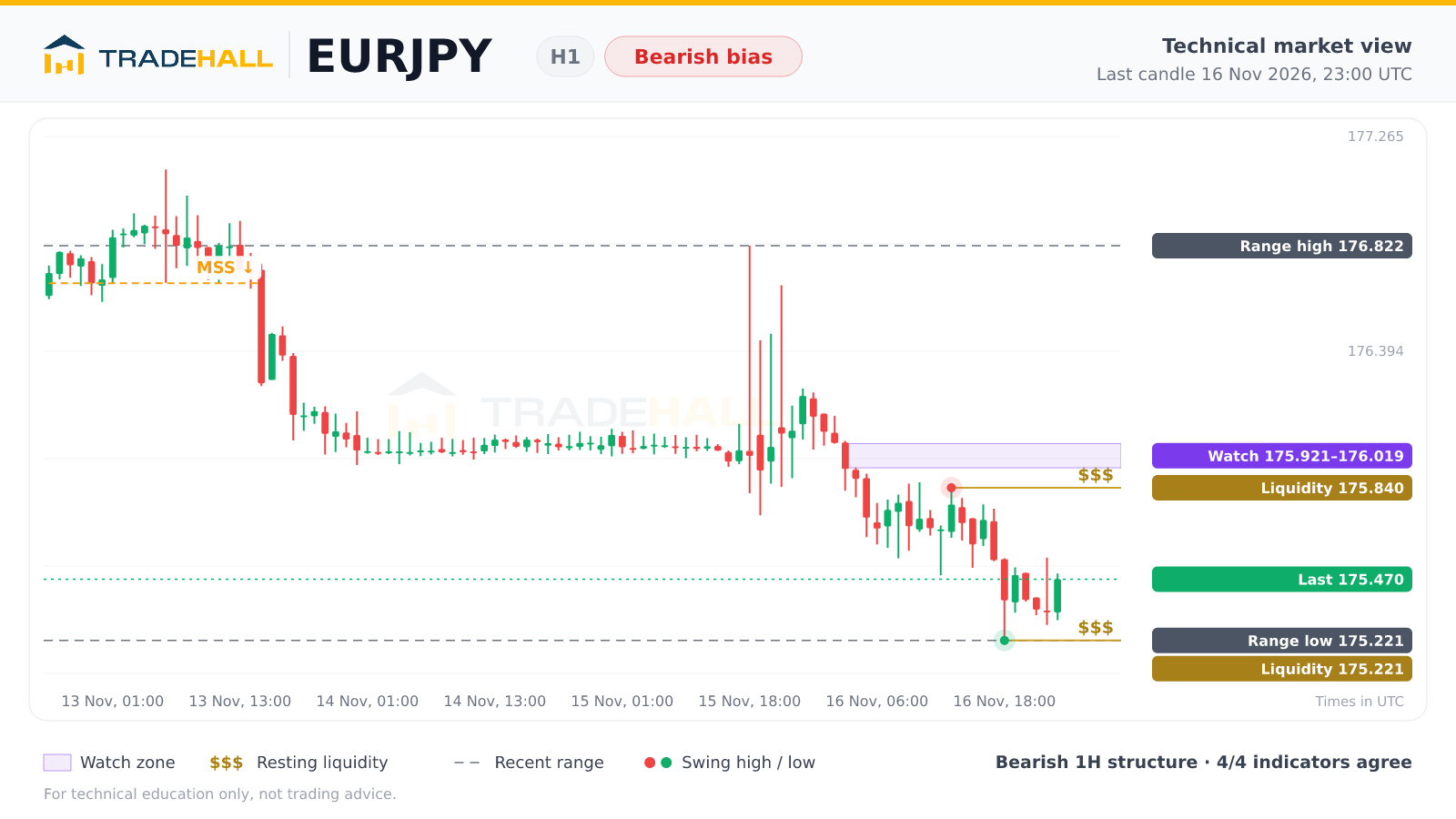
EURJPY analysis, 17 November 2026. The euro weakened amid concerns about France's public finances, while BOJ policymaker Hajime Takata called for a swift rate increase. The ECB's euro-yen reference rate fell to 175.78 from 176.83 on Friday. The EURJPY H1 last close was 175.470 at 16 November 2026, 23:00 UTC, with a strong bearish bias.
What is driving the market
Euro weakness and the prospect of higher Japanese rates are relevant to both sides of EURJPY. French fiscal concerns weighed on the euro, while Takata's call could support the yen through higher rate expectations. Japan's soft growth data complicates the BOJ policy picture. Rising euro zone yields and ECB rate expectations provide a counterweight for the euro.
- dpa-AFX, 16 November 2026, 15:57 UTC: The euro fell against the dollar amid stronger US rate expectations and French fiscal concerns. The ECB's euro-yen reference rate also declined.
- Reuters, 16 November 2026, 04:27 UTC: Takata called for the BOJ rate to move promptly toward the middle of its estimated neutral range. He cited inflation risks and the effect of low real borrowing costs on the yen.
- Reuters, 16 November 2026, 01:07 UTC: Japan's economy unexpectedly contracted in the third quarter. The yen was little changed against the euro early in the session.
- Reuters, 16 November 2026, 10:17 UTC: German yields rose as strong US data heightened inflation concerns. Euro short-term rate forwards implied a higher ECB deposit rate by late 2027.
Technical picture
The H1 bias is bearish with strong confidence, as lower highs and lower lows indicate sellers are in control. MACD, RSI, Stochastic and MA trend are down, with 4 of 4 indicators agreeing. These indicators confirm the structure rather than set its direction. The last close sits near the range low and below the midpoint of the recent range.
The watch zone is a fair value gap above the last close, where price has reacted before. A reaction there could show whether sellers remain in control. Resting liquidity sits above the last close and at the range low. The range high marks the level whose recovery and hold could challenge the bearish structure.
- Bias: bearish (strong).
- Indicator agreement: 4 of 4 indicators agree.
- Recent range: 175.221 to 176.822, midpoint 176.022.
- Watch zone: 175.921 to 176.019 (fair value gap).
- Resting liquidity above: 175.840.
- Resting liquidity below: 175.221.
- Typical daily move: 1.006.
- Last close: 175.470 at 23:00 UTC on 16 November 2026.
How the news fits the chart
The news broadly agrees with the bearish bias, as euro weakness and Takata's rate comments affect opposite sides of EURJPY. Takata's call for a swift BOJ rate increase is a key development because higher Japanese rate expectations can support the yen. Rising euro zone yields offer a counterweight, while the coming ECB events have no predetermined direction.
If price reclaims and holds above 176.822, the lower-high structure could strengthen. A loss of 175.221 could reinforce the bearish structure at the range low. Comments from ECB President Lagarde could also change euro rate expectations and the context for EURJPY.
On the calendar
The ECB President Lagarde Speaks events matter for EURJPY because her comments could affect euro rate expectations. The ECB Financial Stability Review may also shape sentiment toward the euro.
| Time (UTC) | Currency | Event | Impact | Forecast | Previous |
|---|---|---|---|---|---|
| 18 November 2026 09:00 | EUR | ECB Financial Stability Review | Medium | - | - |
| 18 November 2026 14:25 | EUR | ECB President Lagarde Speaks | Medium | - | - |
| 19 November 2026 13:30 | EUR | ECB President Lagarde Speaks | Medium | - | - |
| 20 November 2026 08:15 | EUR | ECB President Lagarde Speaks | Medium | - | - |
Levels to watch
- 175.221: The range low also holds resting liquidity below price. A loss of the area could reinforce the lower-low structure.
- 176.822: The range high marks the upper edge of the recent range. A reclaim and hold above it could challenge the bearish structure.
- 176.022: The recent range midpoint sits just above the watch zone. A sustained move back above it could suggest the bearish structure is weakening.
- 175.921 to 176.019: The watch zone is a fair value gap where price has reacted before. Rejection there could show sellers remain in control.
- 175.840: Resting liquidity sits above the last close. A reaction around it could show whether the lower-high structure remains intact.
How to read this analysis
This note is built from the technical read of TradeHall's AI Analysis, a page of the TradeHall client platform. The bias is the direction the structure leans, and the confidence says how firm that read is. The recent range is the area price has moved in lately, with its range high, range low and midpoint. A watch zone is an area where price reacted before and may react again. Resting liquidity marks levels where orders tend to gather. None of these is an instruction: they describe the chart.
Frequently asked questions
What is the technical bias on EURJPY today?
EURJPY closed its last H1 candle at 175.470 (23:00 UTC, 16 November 2026). The technical read is bearish and strong: 4 of 4 indicators agree with it. Price is inside a recent range from 175.221 to 176.822.
What is moving EURJPY right now?
Euro weakness and the prospect of higher Japanese rates are relevant to both sides of EURJPY. French fiscal concerns weighed on the euro, while Takata's call could support the yen through higher rate expectations. Japan's soft growth data complicates the BOJ policy picture. Rising euro zone yields and ECB rate expectations provide a counterweight for the euro.
Which economic events matter for EURJPY this week?
The ECB President Lagarde Speaks events matter for EURJPY because her comments could affect euro rate expectations. The ECB Financial Stability Review may also shape sentiment toward the euro.
Which price areas matter on EURJPY right now?
Recent range: 175.221 to 176.822, midpoint 176.022. Watch zone: 175.921 to 176.019. These are areas where price may react. They describe the chart and are not instructions.
Is this analysis trading advice?
For technical education only, not trading advice; not a win-rate or probability, and does not guarantee profit.
Sources
- dpa-AFX: Foreign Exchange: Euro Falls to Lowest Level Since April 2025
- Reuters: Hawkish BOJ policymaker Takata calls for swift hike in rates to 'good' position
- Reuters: Yen steady against euro and dollar after soft Japanese GDP data
- Reuters: Euro zone yields rise as traders bet on three ECB hikes by late 2027
For technical education only, not trading advice; not a win-rate or probability, and does not guarantee profit.